How artificial intelligence transforms small, mid-size and large companies
Over the last two decades, very few technologies have reshaped business as deeply as artificial intelligence. But 2025 is not "just another year" on the tech curve: it's the moment when companies that don't adopt AI start competing at a real disadvantage.
It’s no longer about whether you’re going to use AI or not, but about how much longer your company can operate without it before losing speed, customers and profitability to competitors who are already using it to automate, decide better and do more with the same team.
At TrendMakers we see this shift every day: small, mid-size and large companies moving from chaos and manual work to AI, automation and data systems that give them a clear edge. This article is designed so you can recognize yourself in these situations -- and, more importantly, so you don't miss the window of opportunity.

1. How AI changes small, mid-size and large companies
Most conversations about AI stay at the tool level (“we tested this model”, “we’re using that chatbot”). The real impact appears when we look at how operations change across companies of different sizes. That’s where you see the difference between using AI “because you have to” and designing a system around it.
Here’s what we’re seeing in real companies:
- In small businesses, a founder with a well-designed AI system can produce content, reply to leads and prepare proposals at a pace that used to require an entire team.
- In mid-size companies, AI helps organize funnels, prioritize opportunities and automate repetitive tasks that today consume hours of sales, marketing or support teams.
- In large organizations, AI is being embedded into critical processes: forecasting, pricing, planning, internal support, daily operations.
- Across all sizes, the pattern is the same: companies that move first with AI gain time, focus and execution capacity compared to the rest.
- This is not a “Big Tech trend”: it’s a silent redistribution of competitive advantage between those who design new systems and those who keep operating with processes built for a pre-AI world.
Company size is no longer an excuse. A small business with a solid AI system can compete better than a larger company that implements AI late or in a disorganized way.
2. Signs your company is already falling behind
If you’re reading this and thinking “we still have time”, chances are that some of these situations are already happening inside your operation. These are not theories: they’re patterns we see again and again when we diagnose businesses.
If you recognize yourself in more than one of these, the gap with AI adopters has already started:
- Your team is still entering data manually into spreadsheets or messy CRMs.
- Customer responses still depend on whoever sees the email or WhatsApp first.
- You don’t have a single place where you can see what is happening with each lead, opportunity or client.
- Leadership meetings rely more on gut feeling than on real-time data.
- You know you “should be doing something with AI”, but there’s no clear plan or owner yet.
- You’ve already heard that your competitors are experimenting with AI… and you’re not sure exactly how.
The problem isn’t that you haven’t started yet. The problem is continuing to add complexity without a system: more channels, more tools, more information… but no clear architecture linking all that to decisions and results.
3. Why the opportunity window is now
Beyond the hype, there are already clear signals that AI adoption is not a passing trend but a structural change in how companies operate. What matters is not only how many are using it, but how their growth trajectory changes when they integrate it properly.
What’s happening globally with companies that integrate AI:
- Most companies that adopt AI strategically report direct improvements in operational efficiency and response times.
- Businesses that embed AI into their sales and marketing processes tend to grow faster than those that only use it in isolation (for example, just for content).
- More and more small businesses include at least one AI use case in their daily operations, from automated replies to lead scoring and data analysis.
- CEOs who have already seen concrete AI impact in their business are planning to increase their investment, not reduce it.
- The volume of content, decisions and processes going through AI systems is growing every month. This is not something that will reverse.
The strategic reading is simple: the earlier you build your own AI and automation system, the more time you’ll have to refine it while others are still in the trial phase.
4. What changes in your operations when you integrate AI for real
The big difference is not having “access” to AI (everyone has that already), but how it is embedded into the day-to-day business. When AI stops being an isolated experiment and becomes part of the system, very concrete changes start to appear.
Examples of changes we see in real projects:
- Teams stop doing repetitive work (standard replies, manual reports, basic classification) and focus on tasks that truly require human judgment.
- Leads are automatically prioritized based on intent, context and behavior instead of each salesperson’s personal criteria.
- Reports that used to take weeks appear in almost real-time dashboards, ready to inform investment, commercial focus and expansion decisions.
- Communications stop being generic and mass-broadcast to adapt to each prospect’s or client’s moment.
- Areas that used to work in silos start seeing the same information, with less internal friction and more alignment around concrete goals.
AI doesn’t replace your team — it frees them. The real question is whether you use it to “cut headcount” or to help the people you already have generate far more impact with the same time.
5. It’s not just about using AI: it’s about designing a system around it
Many companies feel they are “already doing something with AI” because they tested a tool, implemented a chatbot or generate content automatically. That’s a good start, but it’s not where competitive advantage truly appears.
What separates a business that “uses AI” from one that truly integrates it:
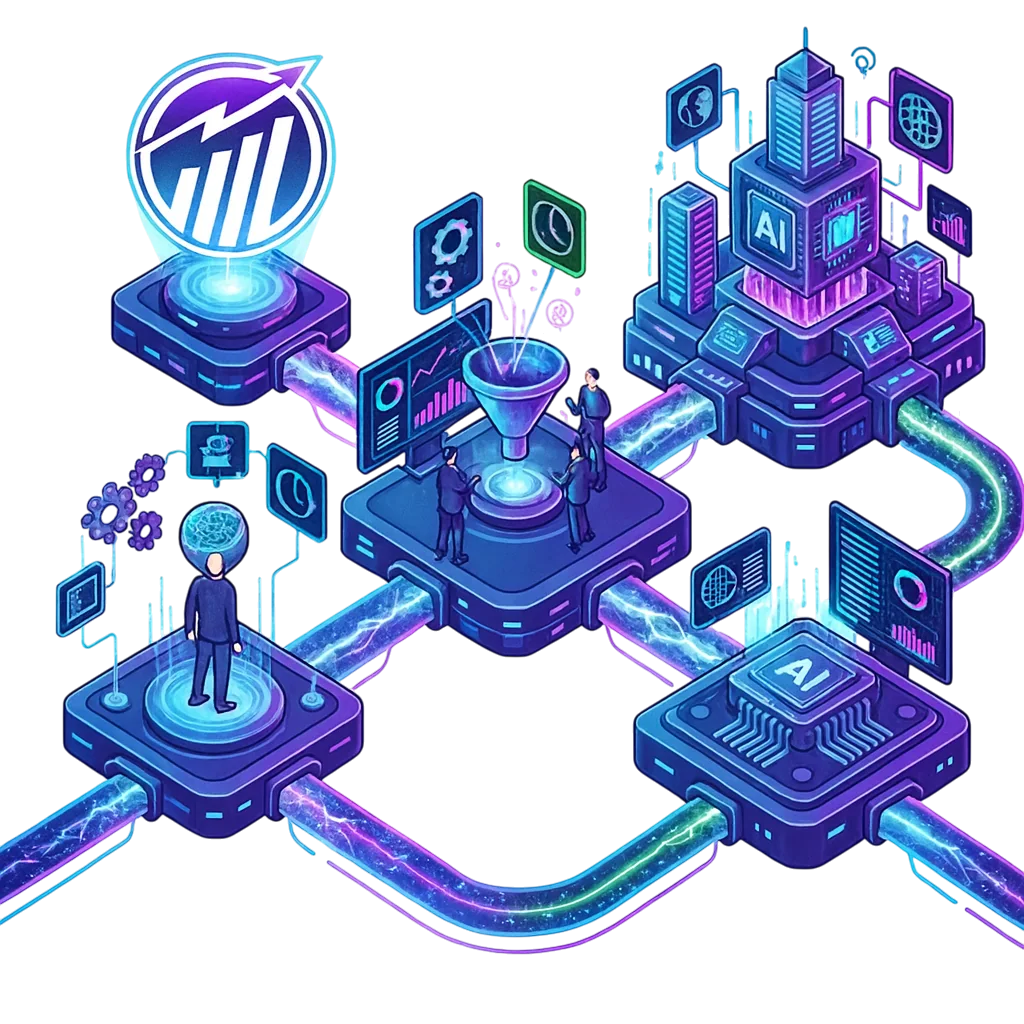
- There is a clear funnel and process map where you can see where AI comes in and why.
- Automations are not isolated hacks but part of a flow that connects acquisition, nurturing, follow-up and closing.
- Data isn’t just stored: it is structured and used to make decisions about investment, commercial focus and prioritization.
- There is a person or team responsible for keeping the system alive, measuring and improving it.
- Internal conversations shift from “let’s try this tool” to “what new use case can we plug into our AI system?”.
The question is no longer whether your company will use AI, but whether you’ll build your own system that gives you an edge — or arrive late to a game where others are already several moves ahead.
Conclusion: decide now whether you want to compete at a disadvantage
Before adding more channels, campaigns or tools, there is a strategic decision to make: will you keep operating with processes designed for a world without AI, or will you redesign your system around what is possible today? You won’t see the impact of that decision in a single day, but it will define how your company competes over the next few years.
Artificial intelligence is not a magic shortcut, but it is a powerful multiplier when combined with strategy, data and automation. Companies that understand this early build a position that’s hard to copy. Those who postpone it end up paying more just to reach a standard others already consider basic.